
No time to read?

When launching a SaaS, the temptation is strong to try everything at once: posting on LinkedIn, writing SEO articles, running ads, emailing prospects, launching on Product Hunt, building a newsletter, chasing partners, and replying to every Reddit comment that vaguely resembles your market.
On paper, this looks like ambition. In reality, it is often the best way to learn nothing.
When you are starting out, your main problem is not being everywhere. Your problem is finding a reliable signal: who responds, to which message, with what pain point, and through which path they agree to move toward your product. To get that signal, you need to reduce the noise. That is precisely why it pays to focus on a single acquisition channel at the start.
At the start, you don't lack channels, you lack signal
A young SaaS usually doesn't have enough data yet to make fine-grained decisions. You don't always know which segment is most urgent, which argument triggers a response, how mature your market is, or which channel will actually convert.
If you test five channels at once, each channel gets too little effort to produce an interpretable result. You publish three LinkedIn posts, write two articles, send 40 emails, put 200 euros into ads, and conclude that nothing works. But that is not a test. It is a series of samples that are all too small.
An acquisition channel almost always requires a learning phase. You need to understand the channel's codes, the rhythm of publishing or prospecting, the formats that work, the recurring objections, the conversion delays, and the type of offer that makes people want to go further.
Focusing on a single channel is therefore not about doing less. It is about doing the same thing long enough to know whether it can work.
Why a single channel really speeds up your acquisition
Focus creates a shorter learning loop. Each action feeds the next one. Every reply, every silence, every meeting, and every objection helps you improve your targeting and your message.
With a single channel, you can isolate variables. If you do LinkedIn outbound, for example, you can successively test your ICP, your hook, your problem angle, your call to action, and your demo offer. If you also keep changing your channel, you no longer know whether the problem comes from the channel, the message, the target, or the product.
Focus also improves execution. A founder who does a bit of everything often stays at a beginner level on every channel. A founder who picks one channel for 60 to 90 days learns the details that matter faster: which profiles accept invitations, which words trigger a reply, which objections keep coming back, which content leads to useful conversations.
Finally, a single channel makes acquisition more repeatable. You can document what you do, measure the results, and later delegate part of the system. In contrast, scattered acquisition often relies on momentary energy. It is hard to analyze, hard to improve, and nearly impossible to hand off.
What focusing on a single channel actually means
Focusing on a single channel does not mean ignoring the rest of the market. You can still talk to customers, ask for introductions, respond to an inbound opportunity, or improve your website. The idea is to choose a primary channel that gets your attention, your volume of action, and your optimization effort.
A primary channel needs to be clearly defined. LinkedIn is not a channel if you post whenever you have time. SEO is not a channel if you write one isolated article without a strategy. Outbound email is not a channel if you send a few untargeted messages whenever your pipeline is empty.
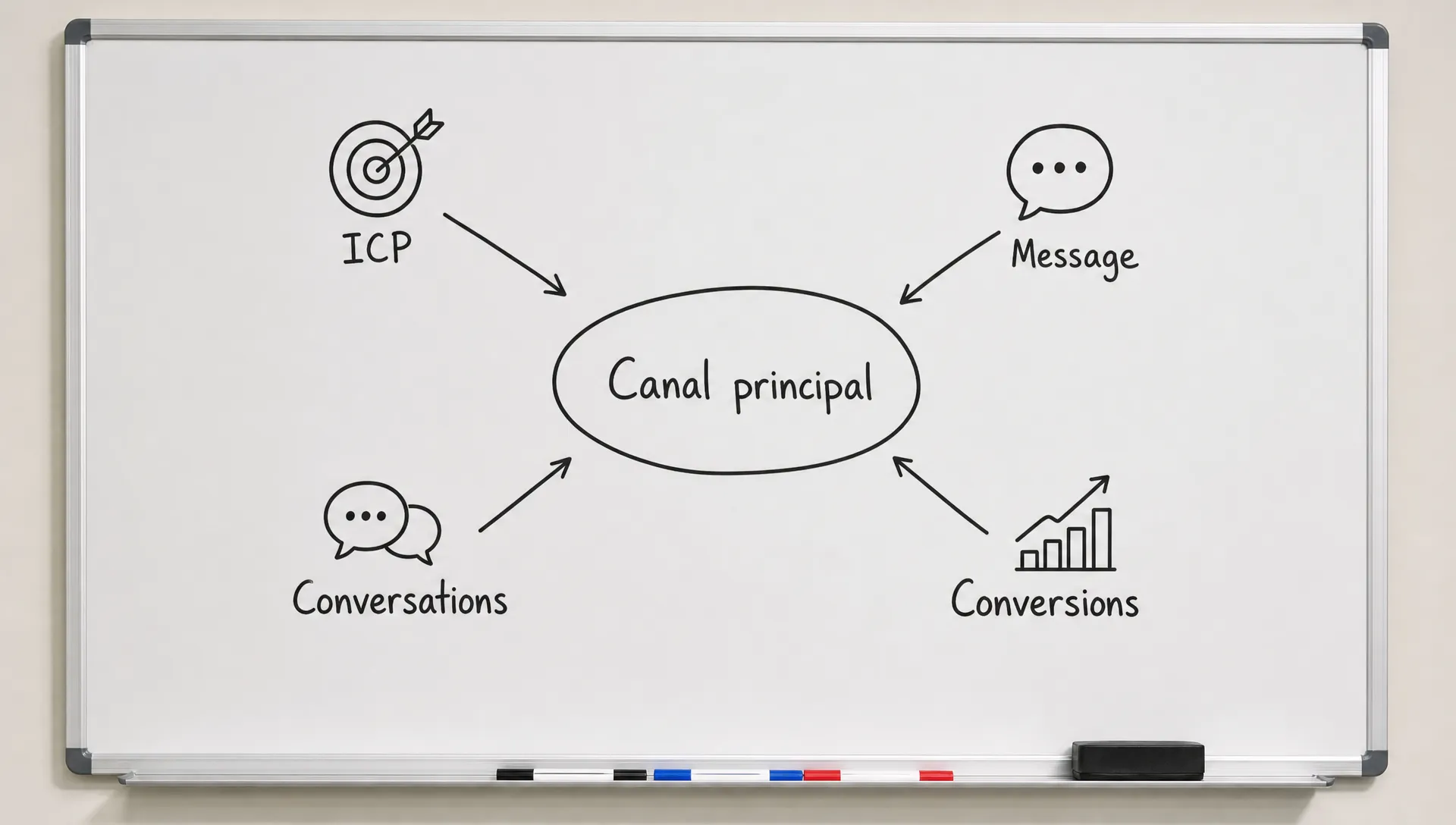
A real acquisition channel looks more like a system: a precise target, a repeated action, a tested message, a progress metric, and a review cadence. It is this repetition that turns a channel into a potential growth engine.
If you are torn between several options, you can start from a broader look at your SaaS acquisition strategy, then select the channel that offers the best trade-off between learning speed, access to your target, and execution capacity.
How to choose your starting channel
The right starting channel is not always the most popular one. It is not necessarily the one you prefer either. It is the one that gives you the fastest actionable feedback from the right target.
For a B2B SaaS with a high average deal size and an identifiable target, outbound can be relevant, because you can quickly talk to specific prospects. For a heavily searched tool with clear intent, SEO can become an excellent engine, but it takes more time before producing meaningful volume. For a product aimed at an audience of founders, freelancers, or marketers, LinkedIn can build trust and conversations fairly quickly.
The choice also depends on your stage. If you haven't validated your ICP yet, look for a channel that favors conversations. If your ICP is clear but demand is already expressed on Google, SEO content can be a priority. If your market actively compares solutions, comparison pages, use cases, and search intent can become more important.
| Starting situation | Often-relevant channel | Why |
|---|---|---|
| Very identifiable ICP and significant B2B deal size | LinkedIn or email outbound | Gets you replies and meetings quickly |
| Problem already searched on Google | Targeted SEO | Captures existing demand with long-lasting value |
| Market educated by trust and expertise | LinkedIn or newsletter | Helps build a relationship before conversion |
| Simple product, impulse purchase, or very clear offer | Ads or marketplace | Can speed up testing if tracking is clean |
| Target hard to reach directly | Partnerships or communities | Uses access points already trusted by the market |
There is no universal rule. But there is one common bad rule: choosing a channel because everyone is talking about it. Your starting channel should be suited to your ICP, your price, your sales cycle, and how clearly you understand the problem.
The signs you spread yourself too thin too soon
Scattering rarely feels obvious at the start, because it creates a sense of activity. You feel like you are moving forward because you are producing lots of small actions. Yet the signals are often visible.
You switch channels as soon as the first results are slow to appear. You have no primary metric per channel. You can't explain why one message worked better than another. You spend more time hunting for new tactics than repeating what might work. You compare your results to those of much more mature SaaS companies, with bigger budgets, stronger brands, and longer track records.
Another frequent sign: your learning stays fuzzy. After a month, you know you were busy, but you can't say which segment reacted the most, which pain point drove the most interest, or which step is blocking conversion. If your month of acquisition didn't teach you something specific, you probably spread your effort too thin.
A simple plan to stay focused for 90 days
Focus doesn't mean shutting yourself off blindly. You can structure your test over 90 days to learn fast, without changing direction every week.
Days 1 to 15: form the hypothesis
Start by writing a simple hypothesis: for which target, with which problem, through which channel, and with which entry offer. For example, you might decide to test LinkedIn with SME SaaS leaders who struggle to generate qualified demos, with an invitation to a short audit.
At this stage, clarity matters most. If you don't know precisely who you want to reach, your channel won't be able to compensate. Poor targeting makes even a good channel ineffective.
Days 16 to 45: produce enough volume to learn
Next, you need to create sufficient volume. Not necessarily massive, but consistent. A channel isn't judged after three posts, ten emails, or two articles. It is judged after a real sequence of execution.
During this period, keep the channel stable and mostly adjust the internal variables: targeting, hook, angle, proof, call to action, landing page. The goal isn't to scale yet. The goal is to find the first signs of traction.
If you are comparing inbound and outbound, for example, don't mix them too quickly. Each has its own logic, timelines, and metrics. To clarify this difference before choosing, you can rely on this comparison between inbound and outbound for a B2B SaaS.
Days 46 to 75: fix the weakest link
Once you get initial feedback, look at where the chain is breaking. If prospects aren't replying, your problem may be targeting or your hook. If they reply but don't book a meeting, your entry offer may lack perceived value. If they book a meeting but don't convert, your positioning, demo, or level of proof needs reworking.
This is where focus becomes powerful. Because you repeated the same channel, you can see patterns. You are no longer making general guesses about your market. You are observing concrete behaviors.
Days 76 to 90: decide with data
At the end of the cycle, you can make a sounder decision. Continue if the channel shows clear progress. Pivot the message if the target responds but doesn't convert. Change segment if another profile reacts better. Stop the channel only if you have generated enough volume, tested several angles, and identified a genuine lack of signal.
The question isn't: did this channel explode in 90 days? The right question is: does this channel produce learning and opportunities at an acceptable cost of effort?
The metrics to track so you don't fool yourself
A single channel is useless if you don't measure what's happening. But at the start, avoid overly complex dashboards. You need a few simple metrics, tracked every week.
For a prospecting channel, look at the number of qualified prospects contacted, the reply rate, the number of useful conversations, the meetings booked, and the conversions. For a content channel, look at impressions or rankings, qualified clicks, sign-ups, inbound requests, and the topics that trigger sales conversations.
The trap is measuring only the visible metrics. Likes, impressions, or visits can be useful, but they don't replace the business signal. If your channel generates attention without ever creating a qualified conversation, you need to revisit the link between your content, your offer, and your call to action.
When to add a second channel
You can add a second channel once the first one is sufficiently understood. Not necessarily when it's perfect, but when it's documented, measurable, and repeatable.
A good sign is that you can explain what works: which ICP responds, which message opens doors, which entry offer converts, which cadence is realistic, and which metrics indicate progress. If you can't answer these questions, adding a channel mostly risks adding confusion.
The second channel should also complement the first. If LinkedIn brings you conversations but prospects often ask for resources before deciding, a blog or comparison pages can strengthen conversion. If your SEO attracts traffic but few visitors return, a newsletter can help nurture the audience. If you want to choose between two content channels, this analysis on SEO or social media can help you decide based on your time horizon.
The idea isn't to stay single-channel forever. The idea is not to build a house of cards. A mastered channel becomes a foundation. A second channel added too early becomes a distraction.
The real discipline: saying no to good ideas
The hardest part of SaaS acquisition isn't finding ideas. It's temporarily turning down the ideas that don't serve your main test.
You'll see tempting tactics go by: a new platform, a viral format, a partnership opportunity, an ads playbook, a trending content strategy. Some will be relevant later. But if they pull you away from your primary channel before you've gotten a clear signal, they slow down your learning.
Focusing isn't a lack of ambition. It's accepting that solid growth often starts with a simple loop: a target, a problem, a channel, a message, a measurement, then an improvement.
Once that loop works, you can expand it. Before that, stay focused.
FAQ
Why not test several channels in parallel from launch? Because you risk spreading too little effort across each channel and drawing the wrong conclusions. At the start, you mainly need a clear signal about your target, your message, and your offer.
How long should you test a channel before switching? For an early-stage SaaS, a 60-to-90-day cycle is often more useful than a two-week test. The exact timeframe depends on the channel, but you need enough volume to interpret the results.
What is the best acquisition channel for a B2B SaaS at the start? There is no universal channel. If your ICP is identifiable and your deal size high enough, outbound or LinkedIn can give you fast feedback. If demand already exists on Google, SEO can be a priority.
Does focusing on a single channel mean abandoning the website? No. Your website remains important for converting visitors and clarifying your offer. But your active acquisition energy should be focused on one primary channel during the testing phase.
When should you add a second channel? Add a second channel once the first is documented, measurable, and already delivering reliable signals. The second channel should complement the first, not compensate for a lack of clarity.
Need help choosing your starting channel?
If you're launching your SaaS and torn between LinkedIn, SEO, outbound, content, or partnerships, avoid choosing on a whim.
With Acquisition SaaS, you can get a free, personalized diagnostic to analyze your value proposition, your website, your competitors, your priority ICP, and the best channel to start with. The goal is simple: know who to target, what to do first, and how to structure your next acquisition actions without spreading yourself thin.
Your tailor-made acquisition plan
We read your SaaS and hand you a complete plan: who to target, which channel, what to do.