
No time to read?

When you launch a SaaS, urgency is everywhere. You need to improve the product, redo the landing page, post on LinkedIn, test cold email, talk to customers, prepare a demo, compare competitors, create a lead magnet, think about pricing, and maybe launch ads.
The problem is that wanting to do everything right away often creates an illusion of speed. You fill your days, you check off tasks, you feel like you're in motion. But after a few weeks, the question that actually matters stays blurry: is your SaaS really attracting the right customers?
Growth does not come from piling up actions. It comes from a clear sequence of hypotheses tested in the right order.
The "right away" trap for SaaS founders
At launch, every topic feels critical. If you don't have enough traffic, you want to produce content. If your landing page doesn't convert, you want to redo it. If nobody replies to your messages, you want to change your target. If a competitor posts every day, you want to post more. If your product is missing a feature, you want to code it immediately.
Individually, each of these decisions can seem rational. Collectively, they create noise.
"Right away" is seductive because it reduces short-term anxiety. Doing something feels like regaining control. But in SaaS acquisition, what reassures you is not always what moves you forward. You can spend two weeks improving ten things by 10%, while your real blocker might be a target that's too vague, a promise that's too generic, or a poorly chosen channel.
This is especially dangerous before product-market fit, because your most valuable asset isn't your execution volume yet. It's your ability to learn fast.
Why doing too much actually slows you down
Wanting to move forward on every front at once doesn't slow you down just because you have less time for each thing. It slows you down because you lose clarity, execution quality, and the ability to interpret what's happening.
Work psychology explains this well. The American Psychological Association notes that multitasking often involves context-switching costs, even when the tasks seem simple. In other words, moving from one topic to another isn't neutral. Your brain has to reload the context, pick back up decisions in progress, and find the thread again.
In a SaaS, this cost is amplified. Your decisions aren't isolated. Changing your target changes your message. Changing your message changes your landing page. Changing your channel changes your content format. Changing your offer changes your outreach emails. If you move everything at once, you no longer know what's producing a given result.
You multiply variables without learning anything
Imagine you change your homepage, your pricing, your LinkedIn message, and your target all at the same time. Two weeks later, you get three qualified demos. Good news, but why?
Is it the new promise? The new segment? A better call to action? A post that performed well? Sheer luck?
Conversely, if nothing works, you also don't know what to fix. You might abandon a good target because your message was weak, or reject a relevant channel because your offer wasn't clear.
The real danger of "doing everything" isn't just being scattered. It's the loss of signal.
You confuse speed with agitation
A very busy week can be a bad week if it doesn't reduce any meaningful uncertainty. For an early-stage SaaS, the right question isn't "how many actions did I take?" but "which hypothesis did I validate or invalidate?"
For example, these two weeks don't hold the same value:
| Busy but unfocused week | Focused and useful week |
|---|---|
| 4 LinkedIn posts, 1 partial site redesign, 2 tool trials, 30 generic emails | 15 conversations with a precise target and 1 tested promise |
| Lots of visible activity | One usable learning |
| Hard to know what to improve | Clear decision for what's next |
| Motivation dependent on reactions | Progress based on concrete signals |
The second week can sometimes seem less impressive. Yet it can save months of development, content, or poorly targeted outreach.
The real accelerator: sequencing your decisions
Moving fast doesn't mean launching everything in parallel. Moving fast means identifying the next decision that unblocks the others.
For an early-stage SaaS, some questions have to come before others. You can't correctly choose your channel if you haven't clarified who you want to reach. You can't write a good landing page if you don't know the main pain point. You can't scale a message if you haven't verified that it triggers replies.
Sequence matters more than intensity.
A healthier progression usually looks like this:
| Step | Main question | Example of useful output |
|---|---|---|
| Target | Who has the most urgent, most accessible problem? | One priority ICP, not five segments |
| Pain | Which problem deserves a solution right now? | A clear formulation of the problem |
| Promise | Why is your SaaS a credible answer? | A testable value proposition |
| Channel | Where can this target be reached effectively? | One main channel to start with |
| Conversion | What does it take to turn interest into a meeting or trial? | An optimized page, email, or sequence |
This logic looks simple, but it requires temporarily giving up a lot of things. That trade-off is exactly what creates speed.
What you need to accept not doing right away
The difficulty isn't knowing what to do. It's accepting that you won't do everything now.
You can have a great lead magnet idea, but if you don't yet know exactly who it's for, it risks attracting poorly qualified contacts. You can want to launch an SEO strategy, but if your positioning shifts every two weeks, you'll end up producing premature content. You can want to automate your outreach, but if your manual messages aren't triggering any replies, automation will mostly amplify a bad signal.
The right order depends on your stage, but the principle stays the same: every action should serve a priority hypothesis.
If you're still building your product, ask yourself a simple question: does the next feature validate a business hypothesis, or does it just give you the feeling of moving forward? That's exactly the point of a minimum viable product designed as a testable hypothesis, rather than a miniature version of the final product.
If you're not sure the problem is painful enough, it's better to slow down visible execution and speed up field learning. Good SaaS market research before you code can save you weeks spent on a segment that doesn't feel the urgency to buy.
The simple test: what's your constraint number 1?
To get out of "right away" mode, start by identifying the constraint that's limiting your progress the most today. Not the one you find most interesting. Not the one that's easiest to deal with. The one that's blocking everything else.
Here are four common constraints in SaaS acquisition.
1. The target is too broad
You say your SaaS is for SMBs, freelancers, marketing teams, or HR. But the broader your target, the more abstract your message becomes. You end up writing sentences that nobody disagrees with, but that nobody truly feels either.
A narrower target isn't a cage. It's a starting point. It lets you speak with more precision, find more obvious channels, and spot buying signals faster.
2. The pain isn't urgent enough
Some problems are real but not a priority. Prospects recognize them, find your product interesting, then postpone the decision. This isn't necessarily a product problem. It's often a problem of intensity.
Instead of adding features right away, look for the situations where the problem is already costing time, money, opportunities, or credibility.
3. The promise is too generic
"Save time," "simplify your management," "centralize your data," or "boost your productivity" can be true, but insufficient. An effective promise helps your prospect recognize themselves quickly.
Compare these two phrasings:
| Vague promise | More targeted promise |
|---|---|
| Save time on administrative tasks | Cut in half the time spent chasing unpaid invoices |
| Improve team collaboration | Avoid back-and-forth between sales and customer success after signing |
| Automate your reporting | Send reliable client reporting every Friday with no manual copy-paste |
The second column isn't necessarily perfect, but it lets you test a sharper reaction.
4. The channel doesn't match the market
Not all channels are equal given your ICP, your average deal size, your sales cycle, and the trust you currently have available. LinkedIn can be excellent for reaching founders or visible B2B decision-makers. SEO can be powerful if the demand is already being expressed in search engines. Cold email can work if the target is identifiable and the pain is concrete enough.
The trap is testing every channel a little, then concluding that none of them work. In reality, most channels need a minimum intensity before they produce a reliable signal.
A better rule: one main bet per cycle
Instead of thinking in tasks, think in learning cycles. During a cycle, you pick one main bet. You define what you want to learn, how you'll measure it, and what decision you'll make next.
For example, your bet could be: "Customer success managers at B2B SaaS companies with 20 to 100 employees feel the sales-to-CS handover problem strongly enough to accept a conversation."
For two weeks, you can focus your effort on this hypothesis. You adjust your message, you reach out to this target, you analyze the replies, you note the objections. You don't redo your whole site in parallel. You don't switch segments after three rejections. You look for a clean signal first.
This is close to the lean startup logic: build, measure, learn. But in acquisition, "build" doesn't always mean coding. It can mean crafting a promise, writing a sequence, creating a simple page, or running interviews. If you want to dig deeper into this approach, the lean startup method applied to a SaaS helps you choose the riskiest hypothesis before spending too much energy.
How to decide what to do now
When everything feels urgent, use three criteria to prioritize.
- Learning impact: will this action help you make a more reliable decision?
- Proximity to revenue: does this action bring you closer to a prospect, a conversation, a trial, or a sale?
- Dependencies: does this action unblock several other actions?
An action that checks all three boxes often deserves to come before everything else. For example, clarifying your ICP can improve your emails, your landing page, your LinkedIn content, your lead magnet, and your call scripts. Conversely, picking a new font for your site can be nice, but it's rarely a blocker.
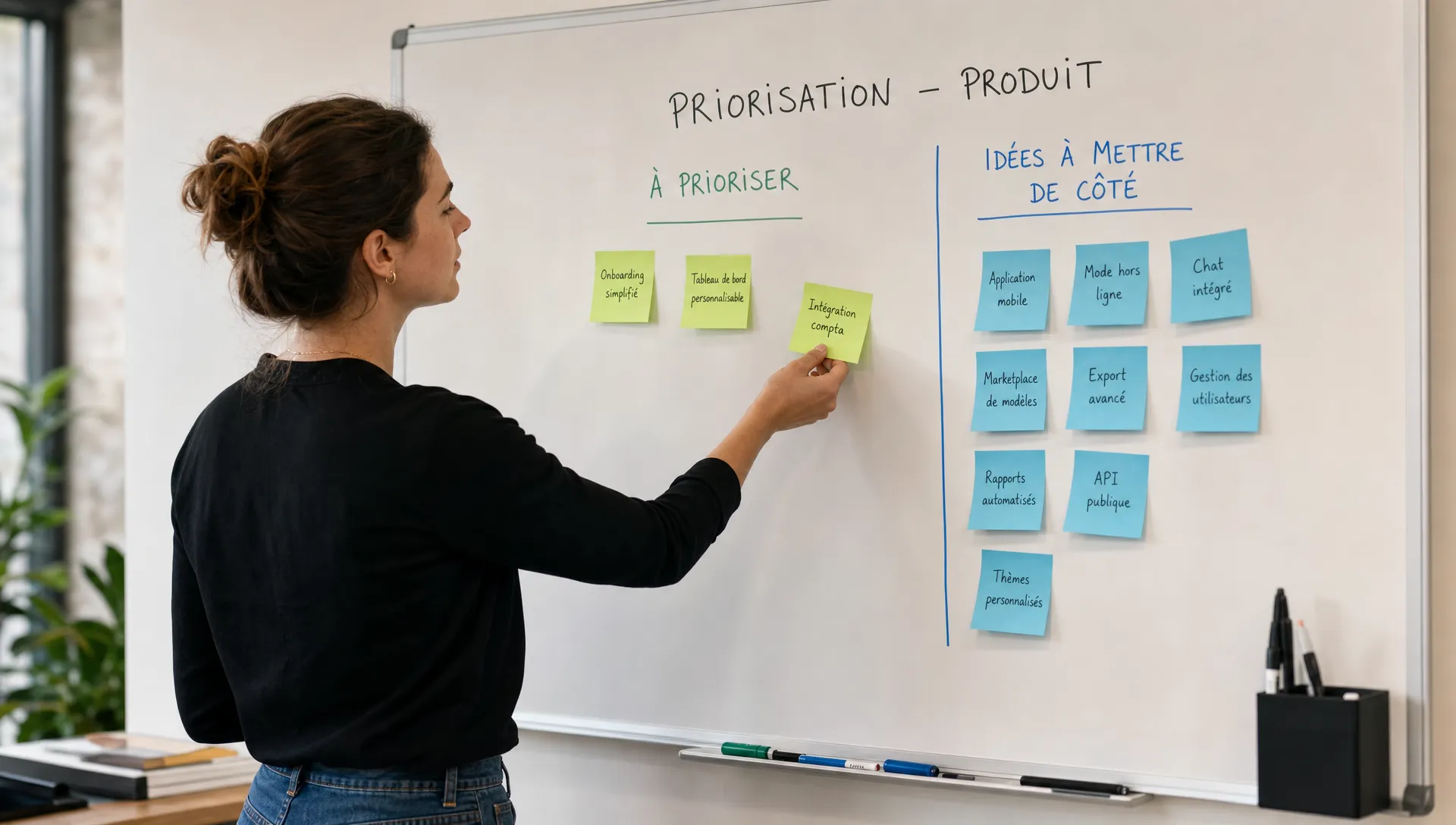
You can also create a "not now" list. It's different from a regular to-do list. It holds the good ideas you're deliberately choosing not to act on during the current cycle. This list reduces the fear of forgetting, without letting you get scattered.
The paradox: doing fewer things speeds up your results
The founders who progress fast aren't the ones who do the most things. They're often the ones who accept doing fewer things, but with better intensity.
They don't post just because they need to be visible. They post to test a precise angle with a precise target. They don't do customer interviews to "take the temperature." They're trying to understand a pain point, a buying trigger, or an objection. They don't redo their site because it "could be better." They change it to improve a clearly defined conversion.
Discipline isn't about working less. It's about protecting your attention from actions that give immediate satisfaction but little learning.
Trying to do everything right away slows you down because your SaaS doesn't need more motion. It needs order. One target, one pain point, one promise, one channel, then an improvement loop.
FAQ
Why does trying to do everything right away slow down a SaaS? Because you multiply variables at the same time. You execute a lot, but you no longer know what's working, what's blocking, and what to improve first.
How do you know which action to prioritize in SaaS acquisition? Prioritize the action that reduces the biggest uncertainty. If you don't know who to target, clarify your ICP before producing content, launching ads, or automating outreach.
Should you focus on a single channel at launch? In most cases, yes. One main channel lets you get a more reliable signal. You can keep other channels on your radar, but avoid spreading your energy too thin too early.
Is it a bad idea to work on the product and acquisition at the same time? No, but both need to answer the same hypothesis. If you code features with no market signal and test channels with no clear target, you risk slowing down both.
How long should you keep a priority before changing it? It depends on the channel and the volume of signals, but avoid changing after just a few days. Set a short cycle, for example two to four weeks, with a precise learning goal.
Clarify your next move
If you feel like you're doing a lot of things without knowing what will actually unblock acquisition, start by getting a diagnosis. Your problem might not be your effort volume, but the order of your priorities.
With Acquisition SaaS, you can get a free personalized diagnosis of your acquisition: priority target, starting channel, site analysis, competitors, and a 60-day action plan. The goal is simple: stop trying to do everything right away, and choose what truly deserves your attention now.
Your tailor-made acquisition plan
We read your SaaS and hand you a complete plan: who to target, which channel, what to do.