
No time to read?

Acquisition playbooks have an obvious appeal: they're reassuring. When you launch your SaaS, it's tempting to look for "the method that works" to generate your first leads, structure your outbound, post on LinkedIn or launch a demo funnel.
The problem is these recipes rarely work as is. They were built in a specific context: a target, a market maturity level, a price, a competitive landscape, a team, credibility already earned. Taken out of that context, they sometimes turn into expensive checklists.
That's where going custom beats generic playbooks. Not because customization is more elegant, but because it avoids copying actions that don't match your market, your ICP or your stage of traction.
The real problem with generic playbooks
A playbook is never neutral. Behind every "send 100 emails a day," "post daily on LinkedIn" or "launch an SEO blog" hide a set of assumptions.
Those assumptions can be valid for one company and false for yours. For example, a high-volume outbound playbook often assumes your target is easy to identify, that your problem is already understood, that your message can be standardized, and that your market accepts a direct approach. If your SaaS sells a complex solution to a highly specialized target, those conditions may not be met.
Same thing for inbound. A generic SEO plan assumes there's already explicit demand on Google, that your prospects search for the problem using stable keywords, and that you can wait several months before converting. If you're creating a new category or your audience doesn't yet articulate its need, publishing 50 articles won't fix your acquisition problem.
A good playbook answers an operational question. A bad playbook, used too early, replaces strategic thinking.
When generic is enough, and when it becomes dangerous
Generic methods aren't useless. They can be very effective when your context resembles the context they were designed for. The danger starts when you apply them before clarifying your constraints.
| Situation | Generic playbook useful? | Why |
|---|---|---|
| Category already well known | Yes | Prospects quickly understand the problem and compare solutions. |
| Very clear ICP | Yes | Targeting, messaging and channels are easier to standardize. |
| Short sales cycle | Often | Test loops are fast and mistakes cost less. |
| Vertical or regulated market | Rarely as is | Expectations, proof and objections vary a lot by industry. |
| Offer still fuzzy | No | The playbook risks amplifying a message that isn't validated yet. |
| High ticket or group decision | No, or with heavy adaptation | Trust, stakeholders and timing become decisive. |
Generic becomes dangerous when it creates a feeling of execution while the real issue lies elsewhere. You can send lots of emails, publish regularly and optimize your site, all while dodging the essential question: "Why should this target change something now?"
If you haven't yet validated how intense the problem is, the first job isn't to industrialize acquisition. It's to understand demand. In that case, an approach like a SaaS market study before you code is often more profitable than a full acquisition playbook.
Going custom doesn't mean reinventing everything
There's a common confusion: believing that custom means starting from zero, with no method, no structure, relying purely on intuition.
That's not the case. In SaaS acquisition, going custom means keeping a decision-making structure, but adapting the variables that actually change performance.
Those variables are usually the following:
- The priority ICP, not just the theoretical segment.
- The urgent problem, not just the feature being sold.
- The starting channel, not just the trendy channel.
- The level of personalization needed in the message.
- The proof to highlight based on perceived risk.
- The buying journey adapted to price and complexity.
In other words, you can draw inspiration from a playbook, but you shouldn't copy it without a diagnosis. The playbook gives you a shape. Going custom picks the right angle, the right order and the right level of effort.
The signals telling you to stop copying
Certain symptoms show that your acquisition suffers less from a lack of execution than from a lack of adaptation.
The first signal is a low response rate despite a correct target. If your prospects genuinely fit your market but don't respond, your message is probably too generic. It describes your product, not their situation.
The second signal is the same objections repeating in demos. If prospects say "it's not a priority," "we already have a tool," "I don't see the ROI" or "this isn't for us," you don't just have a closing problem. You may have an initial framing problem.
The third signal is a gap between traffic and conversion. Your content attracts visitors, but they don't request a demo or sign up. In that case, the channel may be working, but the intent isn't the right one.
The fourth signal is scattered acquisition. You do a bit of LinkedIn, a bit of email, a bit of SEO, a bit of partnerships, without knowing what learning you're after. Going custom often means cutting the number of actions to increase the quality of the feedback.
Example: a vertical SaaS doesn't sell like a horizontal tool
The need for custom acquisition becomes obvious in vertical markets. A SaaS aimed at travel agencies, accounting firms, manufacturers or training organizations can't use the same pitch as a horizontal productivity tool.
In a vertical SaaS, value doesn't come only from the feature set. It comes from understanding the trade, the operational constraints, the specific risks and the language used by the teams.
Take an example in payments. A general-purpose platform might talk about transactions, integrations and security. But a solution like Elia Pay, built for travel agencies, naturally needs to root its acquisition in much more specific topics: multi-mode payment management, bank reconciliation, virtual cards, fraud prevention, tourism-related compliance and cash-flow optimization.
In that context, copying a horizontal SaaS playbook would fall short. The channel, the message, the proof, and even the objections to address must reflect the reality of the industry. The prospect isn't just looking for "a better payment tool." They're looking for a solution that understands their flows, their margins, their suppliers, their risks and their reconciliation constraints.
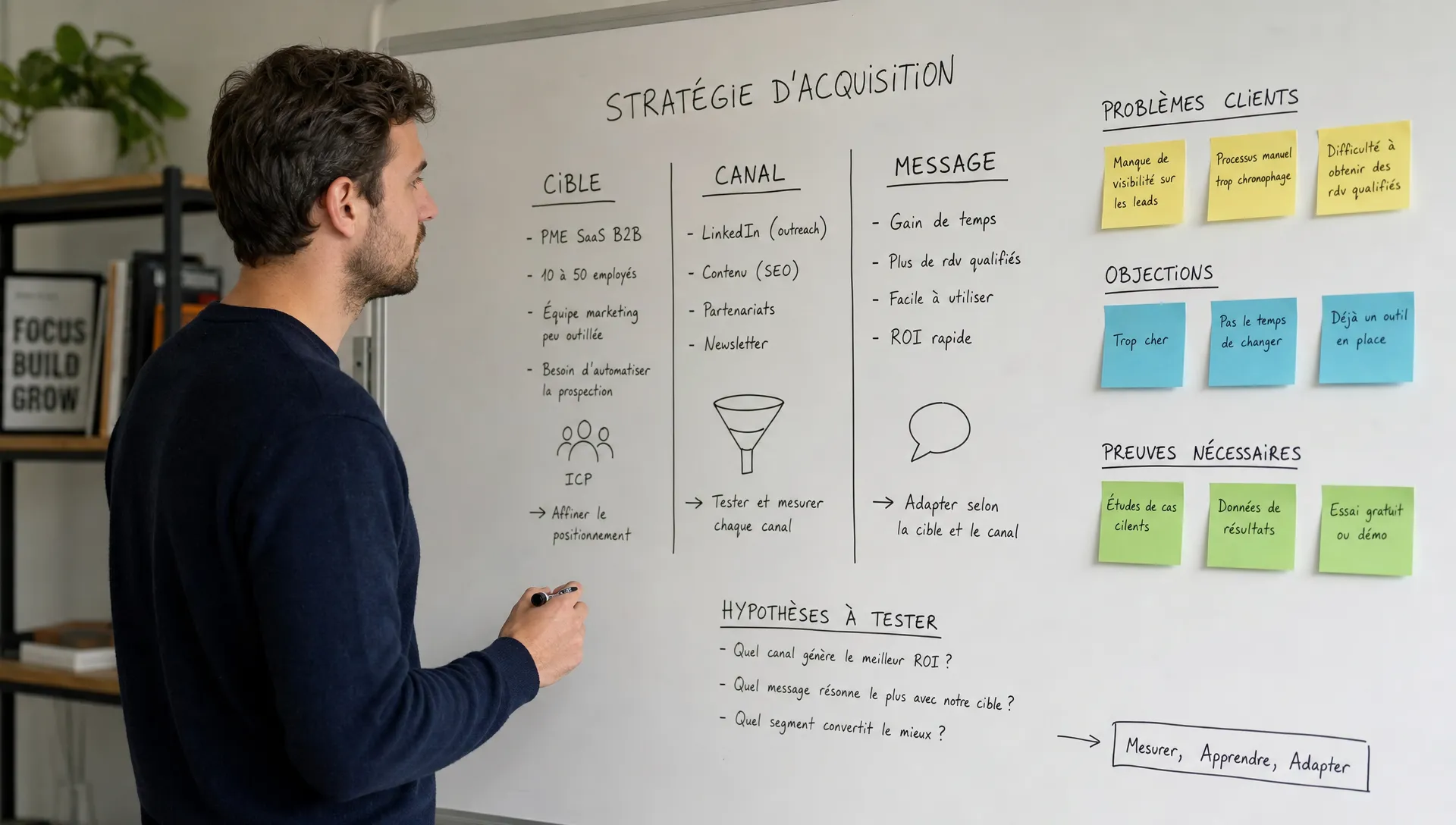
Going custom starts with picking the right ICP
Many SaaS companies try to personalize their acquisition too late. They optimize emails, landing pages or demo scripts, but keep too broad a target.
Yet true custom acquisition often starts with a harder choice: deciding who not to target right now.
An actionable ICP isn't a vague description like "B2B SMBs" or "marketing directors." It's a segment where you can state a precise hypothesis: this person has this problem, in this context, with this urgency, and they have a credible reason to act in the coming weeks.
The younger your SaaS, the more focused your acquisition needs to be. You don't need to prove the whole market can buy. You need to prove one segment can respond, understand, try and pay.
That's also why the "inbound or outbound" debate has no universal answer. The right channel depends on how mature the problem is, how easy the target is to identify, the price, the sales cycle and your ability to build trust. If you're unsure, start by clarifying the real difference between inbound and outbound for a B2B SaaS, then adapt the choice to your context.
The channel is never an isolated decision
A generic playbook often presents channels as independent blocks: SEO, outbound, LinkedIn, ads, partnerships, communities. In reality, a channel only performs if it matches your buying pattern.
If your prospects already know they have a problem and are actively looking for a solution, inbound can be an excellent lever. If the problem matters but is rarely articulated, outbound or educational content may be more relevant. If trust is the main obstacle, partnerships, social proof or founder-led content can be more effective than automation.
Going custom therefore means choosing the channel that maximizes learning and conversion at your current stage, not the one that looks the most scalable on paper.
| SaaS context | Often relevant channel | Adaptation needed |
|---|---|---|
| Problem already searched for | SEO or comparison content | Focus on strong intent, not volume. |
| Identifiable but unaware target | Manual outbound | Personalize the message around the business trigger. |
| High ticket | Sales demo, expert content, network | Reinforce proof and address risks. |
| Simple product, frequent use | Self-serve, PLG, educational content | Reduce friction all the way to activation. |
| Niche market | Partnerships, communities, targeted outbound | Use the industry's language and references. |
Even within outbound, the right setting depends on the stage. Automating too early can burn a limited target with a message that's still weak. Conversely, staying fully manual for too long can prevent you from testing fast enough. That's exactly the trade-off covered in manual outbound vs. automated outbound.
Building a custom plan without losing 3 months
The risk with going custom is falling into endless analysis. You want to understand everything before launching, so you launch nothing. A good personalized plan needs to stay quickly actionable.
The best approach is to turn your context into testable hypotheses. You're not looking for "the perfect strategy." You're looking for the most plausible hypothesis, the shortest test and the most reliable signal.
| Period | Objective | Concrete deliverable |
|---|---|---|
| Days 1 to 10 | Clarify the priority segment | ICP, problem, buying trigger, likely objections. |
| Days 11 to 25 | Test the message | Interviews, first sequences, posts or targeted landing page. |
| Days 26 to 45 | Validate the starting channel | Responses, meetings, sign-ups or qualified requests. |
| Days 46 to 60 | Fix the offer and the proof | Value proposition, use cases, demo, lead magnet. |
| Days 61 to 90 | Double down or pivot | Accelerate the validated channel or change hypothesis. |
This logic is healthier than a fixed plan. It lets you make decisions based on real signals: responses obtained, meeting quality, objections, activation rate, understanding of the promise, ability to convert.
Going custom doesn't slow down execution. Above all, it avoids executing fast in the wrong direction.
Playbooks stay useful as a library, not as a GPS
You shouldn't crudely pit playbooks against personalization. Playbooks are useful when they serve as a library of options. They become dangerous when they serve as a GPS without knowing your destination.
A good SaaS founder can absolutely borrow an outbound sequence structure, a pricing page template, a demo outline or an SEO checklist. But they then need to adapt those elements to their audience, their offer and their maturity level.
So the question isn't: "Which playbook should I follow?"
The better question is: "Which part of this playbook fits my context, and which part needs to change before I launch?"
That nuance changes everything. It stops you from rejecting existing methods, while avoiding applying them mechanically.
How to know if you're over-personalizing
Going custom can also become an excuse. Some founders personalize so much that they never create any repetition. Every prospect gets a different message, every demo changes completely, every segment seems unique.
At that point, you're no longer doing personalized strategy. You're in unmeasurable craftsmanship.
The right balance is to personalize the variables that matter, while keeping a stable foundation. For example, you can keep the same pain hypothesis, the same message structure and the same CTA, while adapting the hook, the use case and the proof to the prospect's context.
If you can't compare two results, you're over-personalizing. If you can compare the responses of the same segment with two different message angles, you're learning.
The right test: does your acquisition reflect your advantage?
The best way to decide between a generic playbook and going custom is to look at your competitive advantage.
If your advantage is operational, for example faster execution or a simpler price, a standard playbook may be enough at first. If your advantage is contextual, for example industry expertise, a specific integration, sector-specific compliance or a deep understanding of a process, your acquisition needs to show it from the very first contact.
A generic message often erases what makes you different. It turns a specialized SaaS into a "time-saving tool," an "all-in-one platform" or a "simple, effective solution." These promises are too vague to create preference.
Going custom, in that case, means making your advantage visible: in the targeting, in the hook, in the proof, in the demo and in the channel.
Frequently Asked Questions
What does going custom in SaaS acquisition actually mean? It means adapting your ICP, your message, your channel and your action plan to your real context, instead of copying a generic method. The goal isn't to reinvent everything, but to change what genuinely influences conversion.
At what stage should a SaaS prioritize going custom? Going custom becomes a priority as soon as your offer, your market or your target aren't fully validated yet. This is especially true before product-market fit, in a vertical market, with a high ticket price, or when the customer problem is still barely articulated.
Are generic playbooks useless? No. They're useful as a starting point, a checklist or a source of inspiration. They become problematic when you apply them without checking the assumptions behind them: target, market maturity, sales cycle, channel and the level of trust required.
How do I know if my message is too generic? If your prospects understand what your product does but don't see why they should act now, your message is probably too generic. A good message should connect your SaaS to an urgent problem, in a specific context, with credible proof.
How long does it take to test a custom approach? In early-stage SaaS, 30 to 60 days is often enough to get the first qualitative signals: responses, meetings, objections, conversions or lack of interest. The goal isn't to prove the whole strategy, but to know what to keep, fix or drop.
Want to know what to personalize first?
The hardest part isn't finding acquisition ideas. It's choosing the right target, the right channel and the right sequence of actions for your SaaS right now.
With Acquisition SaaS, you can answer a few questions, add your site's URL and get a free diagnosis: priority ICP, recommended channel, offer review and personalized action plan. No need to copy a random playbook. Start by finding out what genuinely deserves to be adapted.
Your tailor-made acquisition plan
We read your SaaS and hand you a complete plan: who to target, which channel, what to do.