
No time to read?
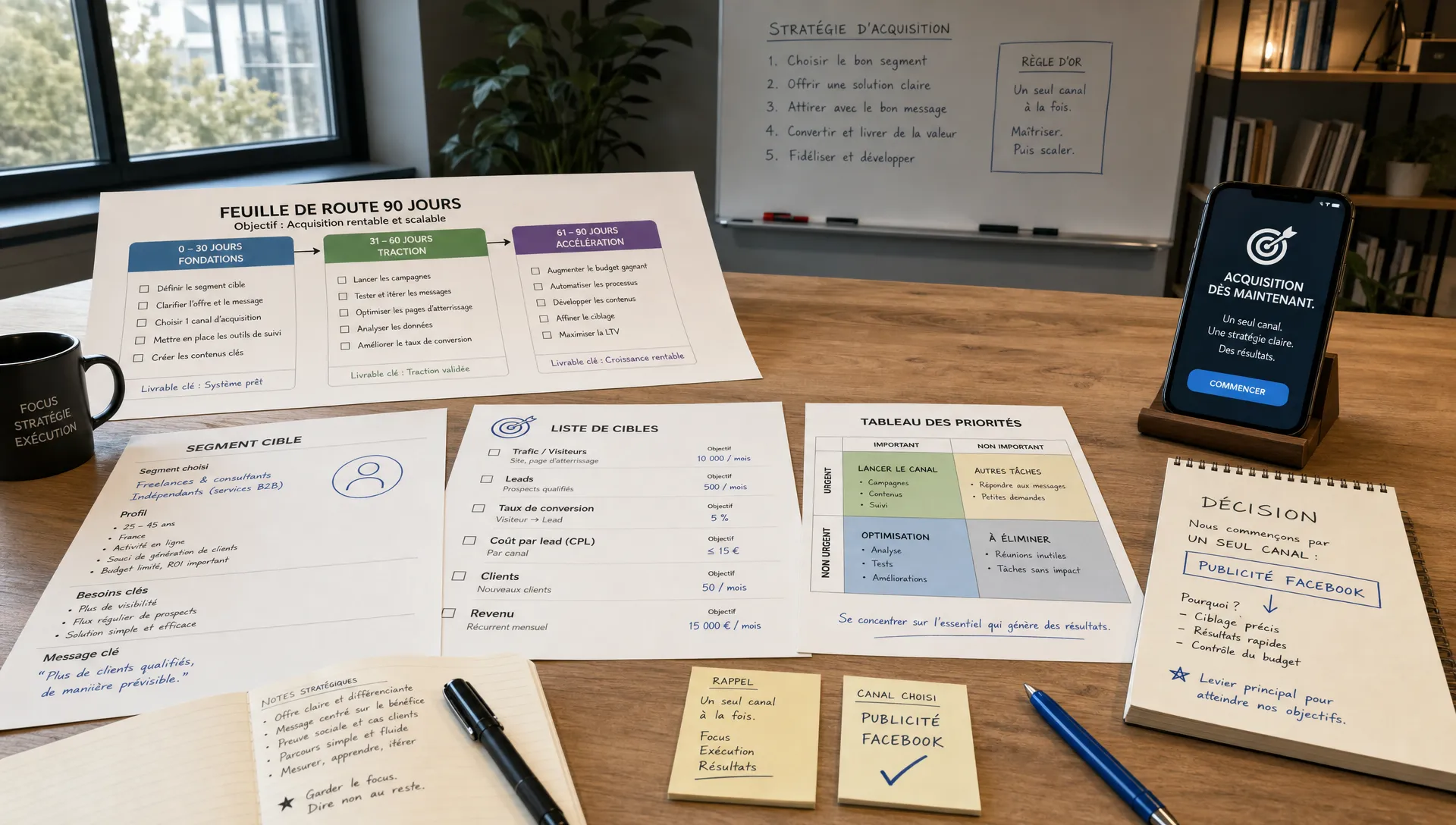
A good SaaS acquisition plan doesn't look like a list of tactics copied from LinkedIn.
It's also not a table full of channels to test all at once, SEO, ads, cold email, webinars, partnerships, Product Hunt, affiliates, content, communities, all of it starting next month.
A good plan looks more like a clear decision: here's who we're targeting, why this target should buy now, which channel we're testing first, what we do every week and how we'll know if it's working.
For an early stage SaaS, that's often the difference between three months of motion and three months of progress. The first gives the impression of working a lot. The second creates conversations, demos, trials, market signals and sometimes your first customers.
The simple test for a good acquisition plan
Open your plan on a Monday morning. If you don't know exactly what to do in the next two hours, it's too vague.
A useful plan has to answer three operational questions:
- Who to contact or attract? Not a broad category, but a segment precise enough to find real people and real companies.
- With what message? Not a generic marketing line, but a promise tied to a pain, a moment or an identifiable cost.
- Which channel to start with? Not every possible channel, but the one that gives your SaaS usable feedback the fastest.
The classic trap is confusing strategy with ambition. Saying "we want to do inbound," "we're going to post on LinkedIn" or "we're going to launch Google Ads campaigns" isn't enough. Those are intentions. A plan turns intentions into a sequence of testable actions.
| Element | Vague plan | Good SaaS acquisition plan |
|---|---|---|
| Target | SMBs, startups, HR, freelancers | A precise segment with size, role, context and buying signals |
| Promise | Save time | Solve a named, visible, priority problem |
| Channel | LinkedIn, SEO, ads, email | One main channel and one secondary channel at most |
| Actions | Post more, prospect, optimize the site | Weekly volume, messages, pages, sequences and ownership |
| Measurement | More traffic, more leads | Qualified conversations, demos, activation, cost and conversion |
| Decision | Keep going if it feels good | Success, iteration or stop criteria defined in advance |
A good plan doesn't need to be long. It mostly needs to be constraining. It forces you to choose, which means temporarily giving up on certain ideas.
The foundation: start from the ICP, not the channel
Most acquisition plans fail from the first line, because they start with the channel.
"Should we do SEO?"
"Does LinkedIn still work?"
"How much should we put into ads?"
These questions are useful, but they come too early. Before choosing a channel, you need to know which target you want to reach. A SaaS selling to founders, to SMB CFOs, to scale-up sales teams or to marketing agencies doesn't have the same sales cycle, the same objections or the same attention spaces.
For a B2B SaaS, the ICP isn't a decorative persona sheet. It's a prioritization filter. It should help you say: this company is worth contacting now, this one isn't.
A usable ICP generally contains:
- The type of company, for example a consulting firm, a software vendor, a franchise network or an industrial SMB.
- The size or maturity level, for example 10 to 50 employees, first sales team, recent funding round or multi-site.
- The buyer or user role, for example founder, head of sales, ops manager, finance lead.
- The trigger, for example hiring, tool migration, rapid growth, new regulation, reporting problems.
- The observable pain, for example repeated manual tasks, lost leads, churn, billing errors, onboarding that's too slow.
If you're looking for your first enterprise customers, this precision matters even more. The guide on B2B SaaS acquisition to land your first customers covers exactly why a broad target costs you early on.
The right move is to narrow the target until you can write a list of 50 to 200 accounts or profiles to test. If you can't build that list, your ICP is still too abstract.
Next: choose a channel based on learning speed
A good SaaS acquisition plan doesn't pick the trendiest channel. It picks the channel that lets you learn fastest with the resources you have.
At launch, your main risk isn't always a lack of volume. It's often a lack of clarity: wrong target, pain too weak, poorly worded promise, no real buying moment, confusing conversion page.
In that context, some channels are better for learning, even if they aren't the most scalable yet.
| SaaS situation | Channel often relevant early on | Why |
|---|---|---|
| New offer, target still uncertain | Targeted outbound or direct LinkedIn | Fast feedback on target, message and objections |
| Problem already actively searched | SEO or Google Ads on precise queries | Captures existing demand |
| Visual product or simple use case | LinkedIn content, short demos, communities | Fast proof of value and easy sharing |
| Complex sale or high price point | Light ABM, network, targeted partnerships | Needs trust and context |
| Market with frequent comparisons | Comparison pages, BOFU content | Traffic closer to the decision |
There's no universal channel. A SaaS at 29 euros a month, self-serve, can't afford the same acquisition approach as a SaaS sold at 12,000 euros a year with a sales demo. Channel choice has to match price, sales cycle, product complexity and team capacity.
If you're torn between several levers, start by clarifying your SaaS acquisition strategy and choosing the right channels. The goal isn't to test everything. The goal is to choose the order of the tests.
What does the plan actually look like?
A good plan often fits on one page. Not because acquisition is simple, but because the complexity has to be hidden behind readable choices.
Here's the most useful structure for a SaaS in launch or early traction phase.
| Plan block | What it should contain |
|---|---|
| Main hypothesis | The target, the pain and the reason to act now |
| Offer being tested | The promise, the use case and the call to action |
| Priority channel | The channel tested for 30 to 60 days without spreading thin |
| Required assets | Landing page, email sequence, LinkedIn profile, lead magnet, demo or onboarding |
| Cadence | Measurable, realistic weekly actions |
| Indicators | Replies, conversations, demos, trials, activation, customers |
| Decision criteria | What triggers an iteration, a pivot or a volume increase |
Let's take a fictional example.
A SaaS helps consulting firms of 20 to 100 people track mission profitability without scattered spreadsheets. A vague plan would say: "we're targeting service SMBs with LinkedIn content and SEO."
A stronger plan would say instead:
| Element | Concrete example |
|---|---|
| ICP | Partners and operations leads at consulting firms of 20 to 100 people |
| Buying signal | Team growth, more projects to juggle, trouble tracking margin and workload |
| Promise | Centralize mission tracking to spot unprofitable projects faster |
| Main channel | Targeted LinkedIn outbound to partners and ops managers |
| Asset | Free 15-minute profitability tracking audit or mission-steering checklist |
| Cadence | 80 targeted profiles a week, 25 invitations, 15 personalized messages, 5 follow-ups |
| Measurement | Acceptance rate, positive replies, qualified calls, recurring objections |
| 30-day decision | Keep the target if conversations confirm an active pain |
This isn't necessarily the perfect plan. But it's a testable plan. After four weeks, you can look at the signals instead of debating in the void.
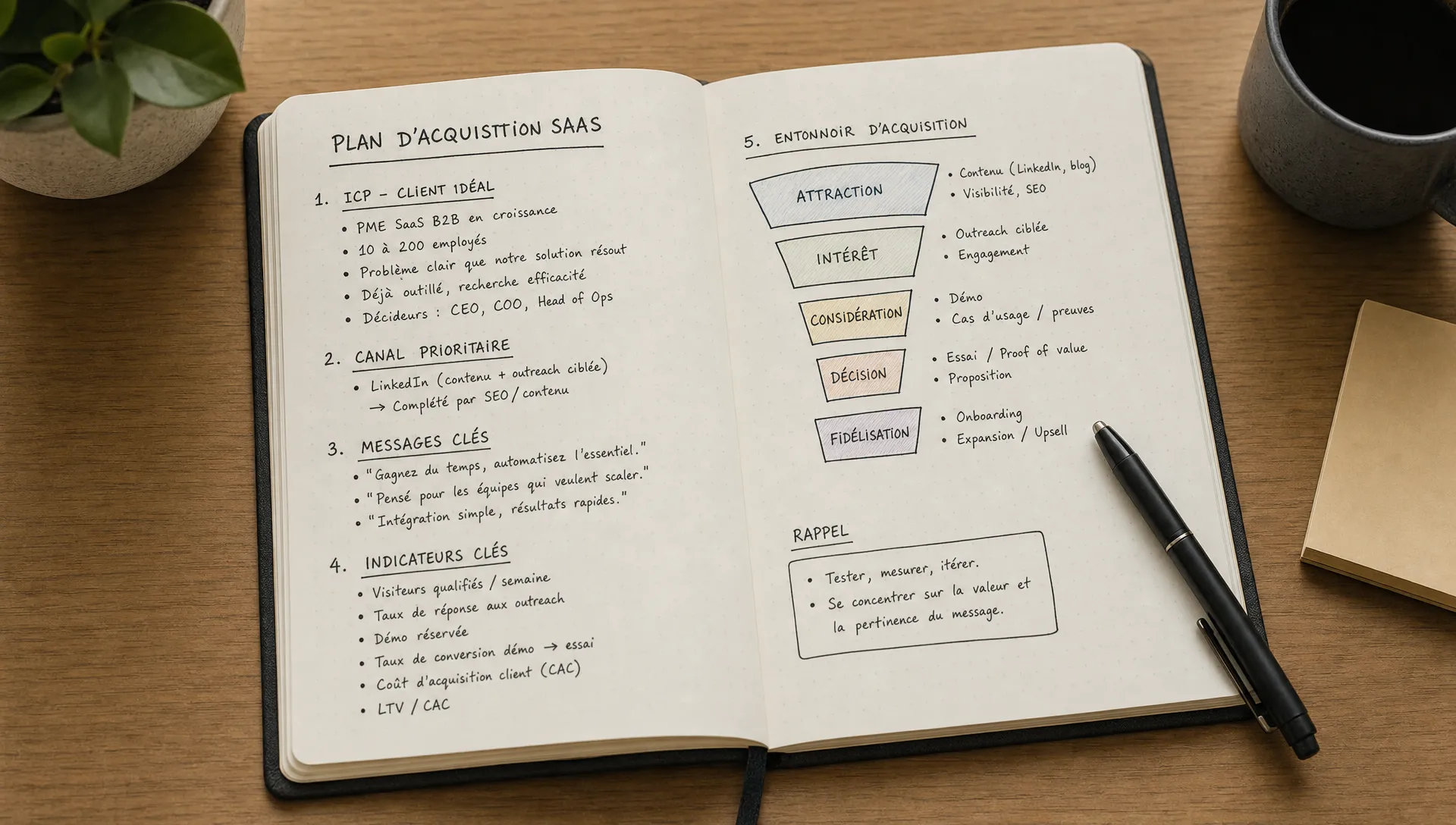
The realistic breakdown over 60 to 90 days
A SaaS acquisition plan has to avoid two extremes. On one side, the plan that's too short, changing direction every week. On the other, the annual plan, too far removed from reality for a SaaS that's still learning.
The right horizon is usually between 60 and 90 days. Long enough to observe trends, short enough to correct quickly.
| Period | Goal | Main work | Expected decision |
|---|---|---|---|
| Days 1 to 15 | Clarify | ICP, competitors, promise, page, account list, messages | Validate the priority segment and starting channel |
| Days 16 to 30 | Test the signal | First messages, first content, first pages, first calls | Identify objections and adjust the promise |
| Days 31 to 60 | Repeat | Stable cadence, sequences, simple CRM tracking, landing page improvements | Know whether the channel produces enough qualified conversations |
| Days 61 to 90 | Scale or pivot | Increase volume, add an asset, test a second segment or channel | Decide what deserves to be industrialized |
The first two weeks are often underrated. Yet that's where the plan gains quality. A solid analysis of the site, the offer and the competitors saves you from spending three months on a message nobody understands.
On the flip side, you shouldn't spend two months preparing before talking to the market. The plan has to push quickly toward real conversations.
The metrics that actually matter
Traffic feels good. Likes are reassuring. Impressions give the illusion of existing. But a good SaaS acquisition plan has to track metrics closer to revenue.
It all depends on the model, but the logic stays the same: measure the move from one stage to the next.
| Stage | Useful metric | What it reveals |
|---|---|---|
| Attention | Qualified visits, profile views, open rate | Is the channel reaching the right audience? |
| Interest | Replies, clicks, relevant comments, downloads | Does the problem resonate? |
| Qualification | Calls, demo requests, trials created | Does the target have a real need? |
| Activation | Use of a key feature, onboarding completed | Does the product deliver first value? |
| Conversion | Paying customers, expansion, sales cycle | Is the acquisition model viable? |
The important point: a good plan doesn't judge a channel purely on raw volume. It looks at signal quality.
A LinkedIn post with 20,000 views but no prospect in the ICP isn't necessarily a win. An outbound sequence with few replies, but three highly qualified conversations, can be far more useful early on.
The plan also has to cover the journey after the click
Acquisition doesn't stop at lead generation. If your plan attracts the right people but the buying journey is inconsistent, you lose the learning along the way.
Before launching a channel, check what happens after the initial interest:
- Does the page clearly explain who the product is for?
- Does the CTA match the expected level of engagement?
- Should the visitor book a demo, start a trial, request an audit or download a resource?
- Does the follow-up sequence help move things forward, or just nudge?
- Are the objections you hear on calls fed back into the page and the messaging?
This point matters especially when you're torn between self-serve and sales demo. A simple, cheap, quick-to-understand product can convert with a free trial. A more strategic or more expensive product will often need a human conversation, proof, a diagnostic or a business case.
A good plan has to connect acquisition, conversion and activation. Otherwise, the marketing team generates leads the sales team finds weak, or the product gets signups who never activate.
What a good plan doesn't contain
A good SaaS acquisition plan doesn't try to impress. It tries to guide.
It doesn't contain fifteen personas, ten priority channels, an overly precise growth projection or goals disconnected from team size. It also doesn't promise that SEO will work in three weeks or that ads will fix a fuzzy value proposition.
It doesn't outsource strategic thinking too early. An agency, a freelancer or a tool can speed up execution, but they don't replace understanding the market. Before outsourcing, you need at minimum a target hypothesis, a promise and a channel to test.
It doesn't try to automate everything from day one. Early on, doing things manually is often an advantage: personalized messages, discovery calls, hands-on onboarding, qualitative analysis of objections. Automation comes once a mechanism starts repeating itself. The same logic applies to internal tools: once growth starts complicating operations, it becomes worth choosing between standard SaaS, assembled tools and custom software to scale, but that choice should come from a real operational need, not a desire to add complexity too early.
The most effective format: a hypothesis, a cadence, a review
If you take away one thing, take away this: a SaaS acquisition plan is a learning loop.
It starts with a hypothesis. It enforces a cadence. It ends with an honest review.
The hypothesis says: we believe this target has this problem, can be reached through this channel and will respond to this promise.
The cadence says: here's what we do every week, without starting from scratch at every meeting.
The review says: here's what the market taught us, here's what we're keeping, here's what we're changing.
This simplicity is powerful, because it protects the team from scattering effort. It keeps you from confusing intuition with validation. It turns acquisition into a system rather than a string of isolated moves.
FAQ
How long does it take to validate a SaaS acquisition plan? It usually takes 30 days to get the first qualitative signals and 60 to 90 days to know whether a channel deserves more investment. It all depends on the sales cycle, the volume of actions and how mature the target is.
Should you test several channels at once? At launch, it's better to pick one main channel and possibly one secondary channel. Testing too many levers at once makes results unreadable, especially with a small team.
What's the best channel for a B2B SaaS? There's no single universal best channel. Targeted outbound, LinkedIn, SEO, partnerships or comparison content can all work depending on price, target, sales cycle and existing demand.
Should an acquisition plan include the website? Yes. The site is part of the plan, because it turns attention into action. Even with a good channel, a confusing page can block conversions and skew your analysis.
When should you review your plan? A weekly review lets you adjust messages and actions. A more strategic review every 4 to 6 weeks lets you decide whether the ICP, the channel or the offer need to change.
Need to see what your own plan should look like?
A good SaaS acquisition plan isn't a generic template to fill in. It depends on your product, your target, your site, your competitors and your maturity level.
If you want to start from a concrete diagnostic, Acquisition SaaS analyzes your offer, your site and your context to help you identify who to target, which channel to prioritize and what to do next. The diagnostic is free, no credit card required, and designed to leave you with a clear action plan instead of a list of abstract tips.
Your tailor-made acquisition plan
We read your SaaS and hand you a complete plan: who to target, which channel, what to do.