
No time to read?
Key takeaways
- Four open source Claude Code skills cover the whole cycle: build, design, get found, sell.
- Each one installs in one or two commands and triggers itself automatically at the right moment.
- The skills replace execution, not your judgment. Distribution stays your real job.
Launching a SaaS solo has never been more realistic. The bottleneck is no longer writing the code, it's holding down every role at once: product, design, SEO, sales. That's exactly where Claude Code skills change the game. A skill is a method file that your agent reads and applies automatically when it detects the right task. You're no longer driving a chatbot, you're running a small team of specialists.
Here are the four skills you can install today to cover the whole journey, from your first line of code to your first customer. They're open source, free, and mostly massively adopted (one has passed 240,000 stars on GitHub). For each one, you get what it does, how to install it, and how to actually use it.
1. Build the product without going off the rails: superpowers
superpowers (over 240,000 stars) isn't just a coding assistant, it's a full methodology. Instead of rushing to write code the moment you describe an idea, the agent steps back, pulls a clear spec out of you, breaks it into readable chunks, then builds a real implementation plan (TDD, YAGNI, DRY). Once you say "go," it launches a development process driven by sub-agents that move task by task, inspecting their own work as they go.
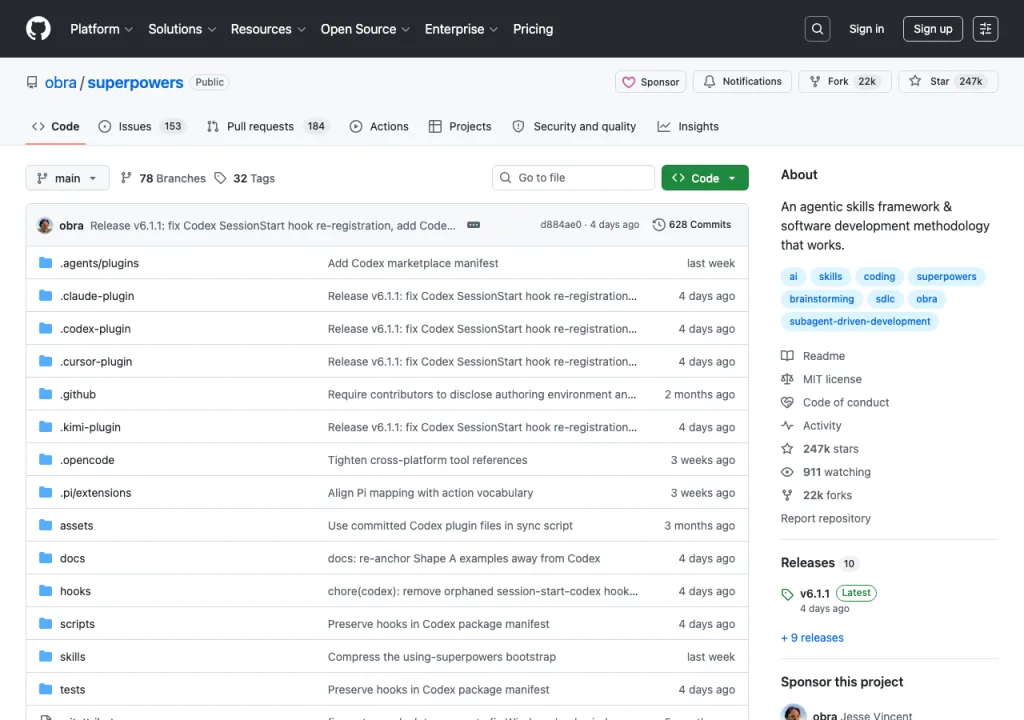
It's the skill that turns "vibe-coding something that mostly works" into "shipping a product you can actually build on." To install it in Claude Code:
/plugin install superpowers@claude-plugins-official
After that, you don't need to do anything special. You describe what you want to build, and the skill triggers itself: it asks you about your real need, shows you the spec, waits for your validation, then executes. Once the plan is approved, it's not unusual for the agent to run on its own for an hour or two without drifting. That discipline, more than raw speed, is what saves you weeks on a real project.
2. A product that looks professional, without a designer: ui-ux-pro-max
A SaaS that works but looks like a free template doesn't sell. ui-ux-pro-max (over 100,000 stars) gives your agent real design intelligence: 161 reasoning rules and 67 interface styles. Its engine analyzes your product type and generates a complete, tailored design system for you: palette, typography, conversion patterns, effects, and, crucially, the list of anti-patterns to avoid (the infamous purple/pink gradient that screams "made by an AI").

Installation takes two commands:
/plugin marketplace add nextlevelbuilder/ui-ux-pro-max-skill
/plugin install ui-ux-pro-max@ui-ux-pro-max-skill
Common mistake
The right way to use it: don't just ask for "a nice-looking page." Describe your product and your target audience ("a billing SaaS for freelancers"), and let the skill propose a coherent system before you start coding. You get an identity, not a patchwork of components.
3. Get findable and readable: marketing-skills
Once the product is standing, people need to find it. marketing-skills (over 36,000 stars) is a collection of marketing skills built for founders who run their own marketing: SEO, copywriting, CRO, analytics, growth. The core piece, product-marketing, describes your product and target audience once, and every other skill leans on it to stay consistent.
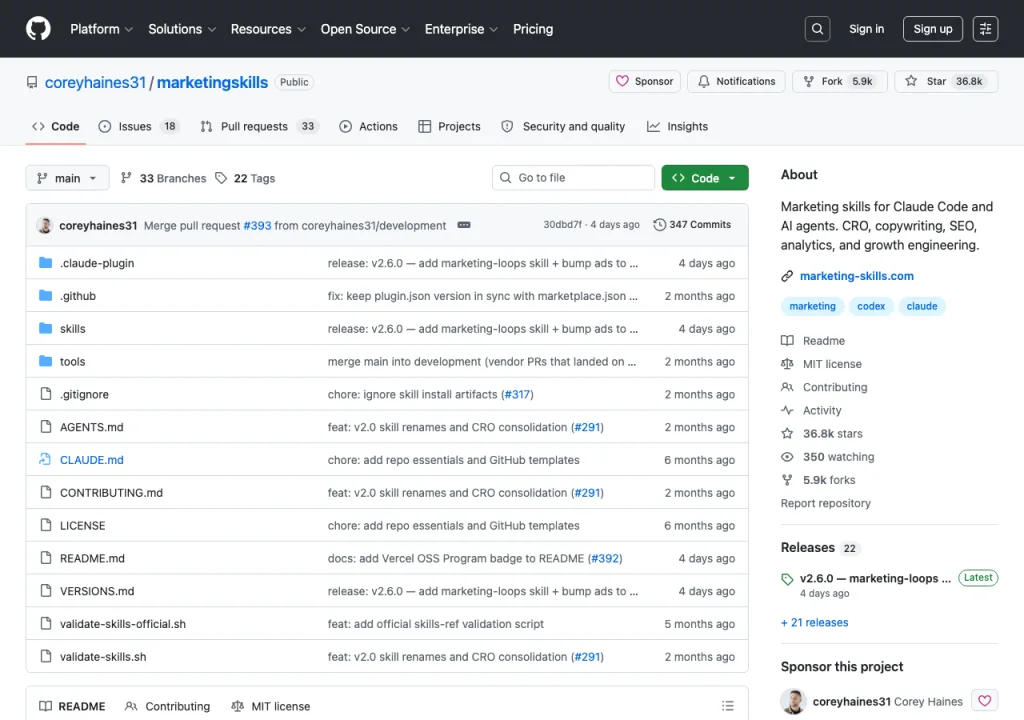
You can install everything at once, or just the skills you need:
npx skills add coreyhaines31/marketingskills
Or, to install only what you need:
npx skills add coreyhaines31/marketingskills --skill seo-audit copywriting analytics
In practice, you can ask "audit my landing page's SEO," "rewrite my hero so it converts," or "set up a clean analytics tracking plan," and the agent applies the right specialist frameworks. This is the role that makes you visible and legible, without an agency.
4. Go get your first customers: ai-sales-team
SEO takes time to pay off. At the start, you'll go get your first customers one by one. ai-sales-team is a more recent project, but formidably practical: 14 skills and 5 parallel agents that turn Claude Code into a sales team. You give it a company, it does the research, qualifies the lead (BANT and MEDDIC), identifies the decision-makers, and preps a personalized outreach sequence for you.
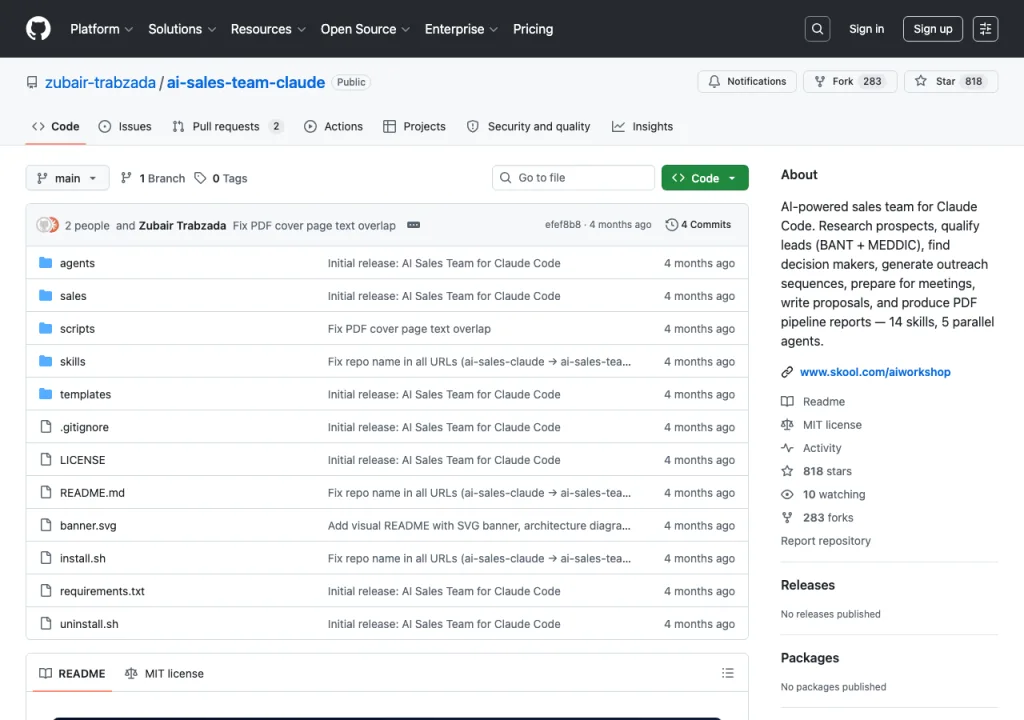
Installation in one line:
curl -fsSL https://raw.githubusercontent.com/zubair-trabzada/ai-sales-team-claude/main/install.sh | bash
Then, a single command does the job:
/sales prospect https://example.com
The agent launches its five searches in parallel and hands you a prospect score, the right contacts, and a ready-to-send email sequence. You keep control of what matters (the conversation), it handles all the thankless research and prep work.
The order to wire them in
Installing all four at once is pointless if you don't know when each one comes into play. The order that makes sense when you're starting from zero:
superpowers first
ui-ux-pro-max once you have an MVP
marketing-skills to lay the foundations
ai-sales-team for your first 10 customers
What it actually costs
All four skills are open source and free. What you pay for is your agent usage, not the skills themselves. The real variable is tokens: superpowers runs sub-agents in parallel, and ai-sales-team fires off five agents at once on a single prospect. In other words, the more you automate, the more you consume. On a small plan, you'll quickly start rationing yourself, and rationing yourself slows you down without you even noticing. If you're planning to actually build and distribute in parallel, a plan with a large token quota often pays for itself in a single session: you stop counting, and you let the agents finish the work instead of cutting them off mid-flight.
The trap to avoid
These four skills give you the execution power of a team. But they don't replace the one thing that actually decides your SaaS's fate: knowing who you're selling to and through which channel. Shipping a clean product has never been this fast, and that's exactly why building it is no longer enough to stand out. Code is 20% of the work. The remaining 80% is distribution, and it's the role founders push off the most.
In other words: use these skills to move fast on what's become easy, and save your energy for the part nobody can automate for you. The best acquisition channel isn't in a skill, it depends on your product, your audience, and your price. That's the analysis you need to do before spending an hour on the wrong lever. To know where to start, our guide to finding your first customers breaks down the channels that actually work at launch.
Frequently asked questions
- What is a Claude Code skill?
- A skill is a markdown file (SKILL.md) that gives your agent expertise and a method for a specific task. When you work on that task, the agent recognizes the context and automatically applies the right frameworks. You install it once, and it triggers itself at the right moment.
- Do you have to pay for these skills?
- No, all four skills in this guide are open source and free. You only pay for your agent subscription (Claude Code), not the skills. A plan with a solid token quota is recommended if you plan on running several agents in parallel.
- Do these skills really replace a team?
- They replace execution, not judgment. A design skill gives you a coherent system, but you're the one who decides on positioning. A sales skill preps your outreach, but you're the one talking to your first customers. They save you the time of a competent junior on every role, not the vision.
- Which one should you start with?
- Superpowers, because it structures your entire way of building. Once your product is moving, you add design, then the distribution skills. Coding is the easy part: save your energy for distribution.
Your tailor-made acquisition plan
We read your SaaS and hand you a complete plan: who to target, which channel, what to do.