
No time to read?
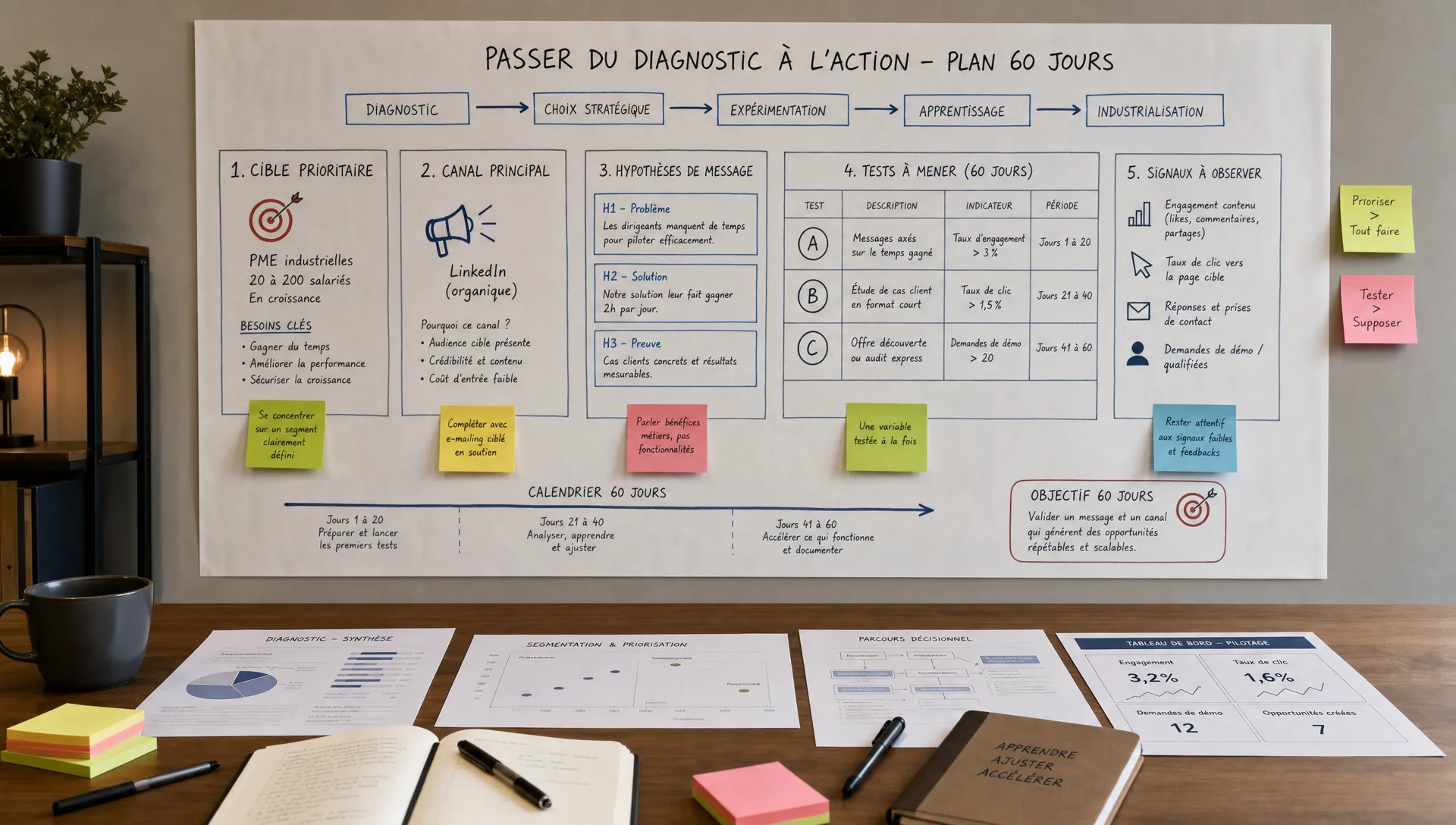
A SaaS diagnostic is not an end in itself. It is a decision tool. Its value does not come from the number of recommendations you receive, but from your ability to turn those results into clear choices, measurable tests, and weekly actions.
The classic trap is reading the report, spotting three interesting ideas, tweaking two sentences on the site, then drifting back into the fog. A week later, the team is still debating the target, the channel, and the message. The diagnostic created information, but not yet traction.
So the real question is not just: what should you do with the results? The real question is: what decision needs to be made right now to learn faster than your competitors?
Read the diagnostic as a series of decisions, not a checklist
A good SaaS diagnostic usually highlights several dimensions: the priority ICP, how clear the value proposition is, competitors to watch, the acquisition channel to test first, the buying journey, and the actions to launch over the coming weeks.
But not all recommendations carry the same weight. Some are structural, like the choice of target or positioning. Others are tactical, like rewriting a landing page headline, adding customer proof, or launching an outreach sequence.
Before executing, sort the results into three categories:
| Result type | Question to ask | Expected decision |
|---|---|---|
| Target | Who has the most urgent, most accessible problem? | Choose a priority ICP for 60 to 90 days |
| Offer | Does the visitor quickly understand why to buy now? | Rewrite the promise and the key proof points |
| Channel | Where can you generate qualified conversations quickly? | Test one main channel, not four in parallel |
| Journey | Should you sell self-serve, via demo, or via direct conversation? | Align CTA, qualification, and sales follow-up |
| Action plan | Which actions create the most learning? | Prioritize tasks that validate or invalidate a hypothesis |
This reading avoids confusing activity with progress. Adding LinkedIn posts, writing an SEO article, or launching an email campaign only matters if the action answers a specific hypothesis.
Step 1: choose the ICP to test first
The most important result of a SaaS diagnostic is often about the target. Not because ICP is a branding exercise, but because it drives everything else: the message, the channel, the objections, the price, the sales cycle, and the proof you need.
If your diagnostic identifies several possible segments, do not try to serve all of them right away. Pick a single priority segment for a given period. This choice is not permanent, but it needs to be sharp enough to make your actions consistent.
A good starting ICP usually checks four boxes: it feels a clear pain, it can pay, it is reachable through a realistic channel, and it can understand the value without an endless education cycle.
For example, saying your SaaS targets SMBs is too vague. Saying it targets operations managers at consulting firms of 20 to 100 people who lose time on staffing is already far more actionable. You know where to find them, how to talk to them, and which situations trigger the purchase.
Once you have chosen the ICP, translate it into concrete criteria: company size, buyer role, triggering event, tool already in use, observed problem, likely budget. Then verify these criteria through conversations, email replies, demos, or product usage signals.
Step 2: turn the recommended channel into an acquisition bet
When a diagnostic recommends a channel, it is not saying: this channel is magic. It is saying: given your target, your stage, your offer, and your resources, this is probably the best place to learn fast.
The nuance matters. A SaaS acquisition channel does not get validated with one post, three emails, or an ad campaign launched without an angle. It gets validated with a structured bet.
State the bet simply: if we target this profile, with this message, via this channel, then we should get this signal within this timeframe.
Example: if we contact 120 finance managers at B2B startups that just raised funding, with a message centered on cutting reporting time, then we should get at least 8 qualified replies and 3 meetings within two weeks. The exact numbers will depend on your market, but the idea stays the same: define a learning threshold before you judge.
Above all, avoid launching LinkedIn, SEO, outbound, partnerships, and paid search all at once. At this stage, your goal is not to cover every channel. Your goal is to understand where your message creates a reaction. If you are torn between several channel families, the inbound vs outbound comparison for a B2B SaaS can help clarify the effort level, the timeline, and the type of learning to expect.
Step 3: fix the offer before accelerating traffic
Many teams read a diagnostic and immediately focus on the channel. Yet an acquisition problem often hides a clarity problem. If your offer is hard to understand, increasing traffic will only increase the volume of visitors who do not convert.
So look at the results tied to your site, your value proposition, and your competitors as priorities before acceleration. Your page needs to quickly answer five questions:
- Who is the product for?
- What urgent problem does it solve?
- What concrete result does it promise?
- Why believe that promise?
- What is the logical next step?
If someone from your ICP lands on your site and cannot tell within ten seconds whether the product is for them, the problem is not the channel. The problem is the message.
For an early-stage SaaS, a landing page improvement can be more profitable than a new channel. Rewrite the headline, clarify the segment, replace generic phrasing with lived-in situations, add proof even if modest, then adapt the CTA to the buyer's maturity level.
If your SaaS includes AI, pay even closer attention to product adoption. Acquisition can generate trials, but it will not make up for a lack of trust, understanding, or retention. In that case, a playbook like the AI Product Adoption Deck can complement your acquisition diagnostic by helping the product team identify the moments where AI usage actually stalls.
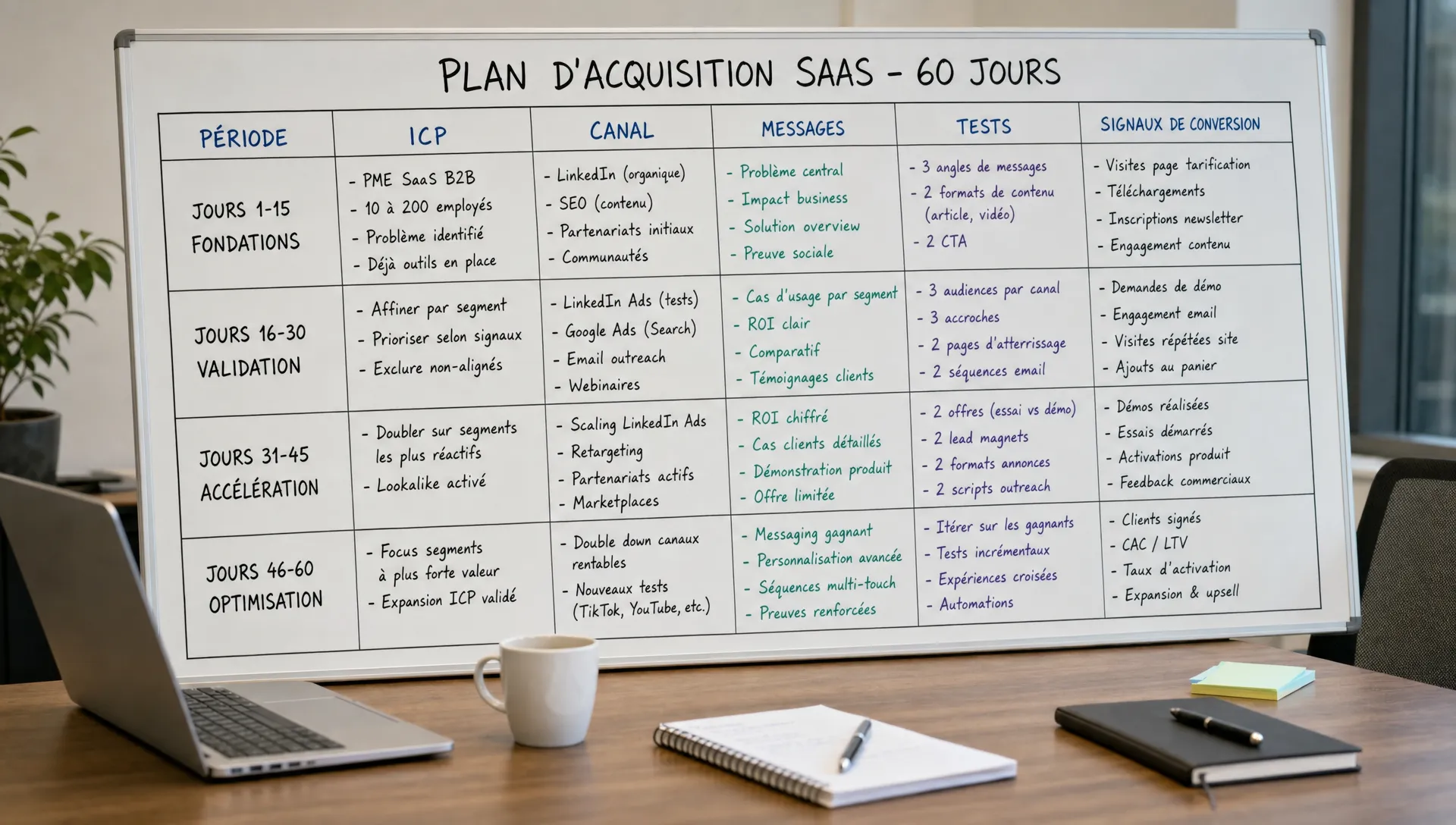
Step 4: turn the results into a 60-day plan
A useful diagnostic has to lead to a short plan. Not a twelve-month marketing roadmap. Not a list of thirty ideas. A 60-day plan is enough to turn the recommendations into actionable signals.
The goal is not to succeed at everything in two months. The goal is to reduce uncertainty about the target, the message, and the channel.
| Period | Objective | Priority actions | Signal to watch |
|---|---|---|---|
| Days 1 to 7 | Decide | Choose the ICP, rework the promise, define the test channel | The team knows exactly who to target and why |
| Days 8 to 21 | Set up | Update the landing page, prepare the messages, build a first prospect list | Assets are ready and consistent |
| Days 22 to 45 | Test | Launch the main channel with sufficient volume | Replies, meetings, trials, signups, or qualified requests |
| Days 46 to 60 | Decide | Analyze the signals, adjust the message, keep or change the bet | A clear decision is made for the next cycle |
This plan should fit on one page. If you need ten Notion tabs to understand it, it is probably too complex. To compare your structure against a more complete approach, you can also look at what a good SaaS acquisition plan looks like, especially if your team lacks a framework for prioritizing.
Step 5: define the right indicators before executing
A recommendation without a metric quickly becomes an opinion. Before launching the actions from the diagnostic, define what you are going to measure and how you will know whether the test deserves to continue.
Do not limit yourself to visible metrics like impressions, likes, or traffic. These signals can be useful, but they do not necessarily prove your acquisition is progressing.
For a SaaS in launch or early traction phase, the most useful signals are usually closer to conversation and intent: qualified replies, demo requests, activated trials, accounts created, repeat usage, recurring objections, opened opportunities, paid conversions.
The right indicator depends on the channel. In outbound, a qualified reply is often worth more than an open rate. In SEO, a signup from a highly intentional query is worth more than a thousand informational visits. On LinkedIn, a conversation with a target buyer is worth more than a viral post reaching an out-of-market audience.
So pair each action with a decision metric. If the test succeeds, you know what to reinforce. If it fails, you know what to learn.
Step 6: align the buying journey with the diagnostic
The results of a diagnostic can also reveal a mismatch between your product, your price, your target, and your conversion journey. Some SaaS products can sell self-serve with a free trial or instant signup. Others need a demo, an audit, a qualification call, or a more consultative cycle.
The wrong instinct is to copy a more mature competitor's journey. If their product is well known, their market educated, and their brand established, their self-serve motion can work where yours still needs education. Conversely, forcing a demo on a buyer who wants to test on their own can create needless friction.
So reread the diagnostic results through this lens: which next step demands the least effort while maximizing trust?
If your product is simple, inexpensive, and immediately understandable, a direct signup can make sense. If the problem is strategic, costly, or involves multiple stakeholders, a demo or a preliminary diagnostic can convert better. To dig deeper into this choice, the analysis on self-serve vs sales demo details the cases where each journey becomes more logical.
What if the results contradict your gut feeling?
This happens often, and it is often exactly where the diagnostic becomes truly useful. Maybe you thought you were targeting startups, but the diagnostic points instead to established SMBs. Maybe you wanted to do SEO, but your market first needs direct conversations. Maybe your site explains the product a lot, but not the problem enough.
In that case, do not take the diagnostic as absolute truth. Take it as a prioritized hypothesis. Your job is to test it seriously, not to accept it blindly or reject it because it is uncomfortable.
Give yourself a short period, with precise criteria. For example: two weeks of prospecting on the recommended ICP, fifteen targeted conversations, an adapted landing page, a consistent email sequence. At the end, compare the signals you got with those from your previous approach.
The worst option is staying stuck between two strategies: keeping your old target while using a new message, testing a channel without volume, or changing the positioning without changing the page. A diagnostic cannot produce results if execution stays ambiguous.
Common mistakes after a SaaS diagnostic
The first mistake is executing everything at once. If you change the target, the message, the channel, the pricing, and the journey the same week, you will never know what worked.
The second mistake is judging too fast. A channel tested with ten messages or an SEO article published three days ago does not give you enough material to conclude. You need to define a minimum volume before the test.
The third mistake is delegating too early. An agency or a freelancer can speed up execution, but only if the strategy is clear. If you do not yet know who to target or which message resonates, delegating mostly risks industrializing the confusion.
The fourth mistake is ignoring objections. Negative replies, silence, and calls that do not convert are data. Write down the exact wording. It often points to what needs to change in your offer, your targeting, or your pitch.
The fifth mistake is turning the diagnostic into a static document. A SaaS diagnostic should stay alive. After each test cycle, update what you believe about the ICP, the channel, the promise, and the journey.
A good result means a sharper decision
After a diagnostic, you should not just have more ideas. You should have less hesitation.
You know which segment to attack first. You know which channel to test before the others. You know which messages deserve to be put in front of the market. You know which pages to fix. You know which signals to watch before continuing, adjusting, or pivoting.
That is exactly the role of a SaaS diagnostic: reduce the noise to create a first learning system. At this stage, speed does not come from the volume of actions. It comes from the clarity of the choices.
FAQ
How long does it take to act on the results of a SaaS diagnostic? You can make the first decisions in a day, update the priority elements in a week, then launch a test cycle over 30 to 60 days. The important thing is not to wait for everything to be perfect before confronting the recommendations with the market.
Do you have to follow every recommendation in the diagnostic? No. It is better to identify the two or three recommendations that reduce the most uncertainty: ICP, promise, channel, or buying journey. The rest can wait for the next cycle.
What if the recommended channel produces no results? First check the volume, the targeting quality, and the clarity of the message. If all three are solid and the signals stay weak, the diagnostic needs to be updated with this new learning.
Does a SaaS diagnostic replace an acquisition strategy? No. It helps you formulate a clearer initial strategy. The strategy becomes robust once you turn the recommendations into tests, then into decisions based on real signals.
Move from diagnostic to action
If you already have results, do not let them sit in a document. Choose your priority ICP, state your acquisition bet, fix your promise, and launch a measurable test over the coming weeks.
And if you do not yet have a clear diagnostic, you can use Acquisition SaaS to get a free, personalized analysis of your target, your site, your competitors, and the best channel to start with, no credit card required.
Your tailor-made acquisition plan
We read your SaaS and hand you a complete plan: who to target, which channel, what to do.